Best Time to Post on X (Twitter) in 2026
Posting at the wrong time can cost you 40% of your potential reach before the algorithm even has a chance to distribute your content. X rewards early engagement velocity — which means timing is a strategic variable, not an afterthought. Here's what the data says, broken down by goal and industry, plus how to find your own best windows.
Why timing matters more on X than other platforms
Most social platforms use a relevance-based feed that surfaces content to users hours or even days after it was posted. X is different. Its feed is still heavily recency-weighted, which means the clock starts the moment you hit publish.
X's ranking algorithm scores posts partly on engagement velocity — how quickly a post collects replies, likes, reposts, and bookmarks in its first 30 to 60 minutes. A post that earns strong early engagement gets pushed to a wider audience via the For You feed and topic recommendations. A post that lands when your audience is asleep earns nothing in that early window and rarely recovers, even if the content is genuinely good.
This mechanism makes timing uniquely high-stakes on X compared to platforms like LinkedIn or Instagram, where algorithmic re-surfacing can rescue a good post that got a slow start. On X, the first hour is almost everything. Post at 2 AM and your best content dies quietly.
The practical implication: two identical posts, one published at 9 AM Tuesday and one at 11 PM Friday, can see 3 to 5 times the difference in reach with zero difference in quality. Timing is not a minor optimization — it is a core distribution lever.
What is the best time to post on X by goal?
There is no single universally optimal posting time. The right window shifts depending on what you are trying to achieve. Engagement (replies, likes), reach (impressions), link clicks, and follower growth each have different audience behaviors driving them.
For maximum engagement (replies, likes, reposts)
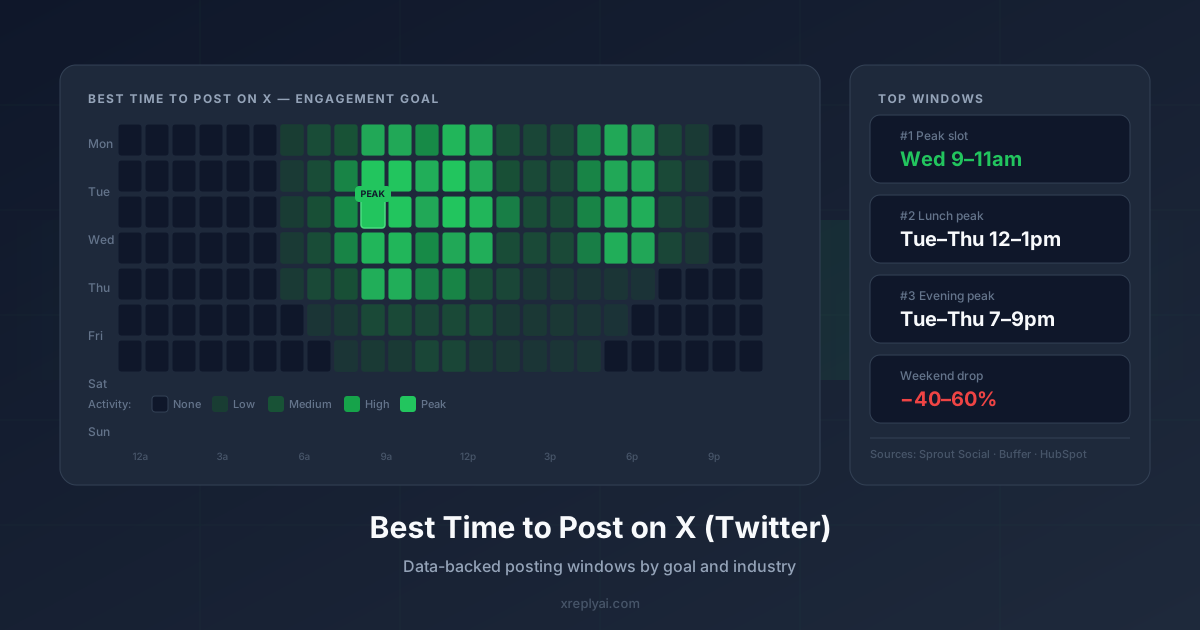
The highest-engagement windows across Sprout Social, Buffer, and HubSpot studies consistently cluster around Tuesday through Thursday, 9–11 AM in the audience's primary timezone. Users are at their desks, in a browsing mindset before deep work, and actively engaging with content. A secondary peak appears at 7–9 PM on the same days, when people unwind after work and scroll casually.
For maximum reach (impressions, For You distribution)
Reach follows engagement — the faster you accumulate early signals, the more aggressively the algorithm pushes your post. Wednesday at 9 AM repeatedly appears as the single highest-reach slot across multiple independent studies. If you can only commit to one optimal time window per week, Wednesday morning is it.
For link clicks (driving traffic off-platform)
Link clicks lag engagement by about 30–60 minutes. Users engage with content first, then decide to click through. This means posting at 8:30–9 AM captures the click-through wave that follows the 9 AM engagement peak. Tuesday and Wednesday mornings are the strongest windows for link traffic. Lunch hours (12–1 PM) perform above average for link clicks too, as users have more time to follow through.
For follower growth
Follower growth correlates strongly with profile visibility, which comes from your content appearing in the For You feed or being reshared into new audiences. The engagement-driven posting windows above (Tuesday–Thursday, 9–11 AM) also produce the highest follower growth rates, since more impressions lead to more profile visits, and more profile visits lead to more follows.
Key data points
- • Wednesday 9 AM: highest single engagement slot across Sprout Social, Buffer, and HubSpot data
- • Tuesday–Thursday 9–11 AM: peak engagement window for most professional audiences
- • Tuesday–Thursday 7–9 PM: secondary peak for consumer-oriented and creator content
- • Saturday–Sunday: engagement drops 40–60% vs. Tuesday–Thursday for most niches
- • Posts published in the first 30 minutes of peak hour see up to 3× the impressions of identical posts published 3 hours later
Best time to post on X by industry
General benchmarks are a starting point. Different audiences have fundamentally different usage patterns on X. A crypto trader and a B2B SaaS buyer are on the platform at very different times for very different reasons.
General / Mixed audience
Tuesday through Thursday, 9–11 AM and 7–9 PM. Avoid posting after 10 PM or before 7 AM. Friday performance begins declining from 3 PM onward.
B2B and SaaS
Business hours dominate. Tuesday through Thursday, 8–10 AM and 12–1 PM are the strongest windows. Your buyers are checking X between meetings or during lunch, not late at night. Weekends should be treated as near-zero-ROI for B2B content — engagement drops 60–70% compared to weekday peaks. If you do post on weekends, Sunday evening (7–9 PM) is the one exception that sometimes performs above baseline.
Creators and personal brands
Creator audiences tend to skew toward evenings and weekends more than professional audiences. Tuesday and Thursday 9–11 AM remain strong, but Saturday 9–11 AM and Sunday 7–9 PM often outperform the same creator's Friday afternoon posts. Consumer-interest niches (fitness, personal finance, productivity) also see above-average Saturday morning engagement.
E-commerce and consumer brands
Broader windows work here. Tuesday through Friday, 12–3 PM performs well because shoppers are in a browsing mindset during lunch and early afternoon. Monday morning underperforms across e-commerce categories — users are in work-catch-up mode and not in a buying headspace.
News, media, and commentary
This category is uniquely tied to when news breaks, not a fixed clock. That said, the morning window (7–9 AM) performs strongly because news consumers check X first thing. Breaking-news commentary that lands within 30 minutes of the event consistently outperforms anything posted hours later, regardless of day. Speed matters more than timing for this niche.
How to find your own best posting windows
Industry benchmarks give you a reasonable starting grid. But your actual best time to post on X depends on when your specific audience is online — and that is something you can measure directly, not just approximate.
Step 1: Pull your analytics data
X Analytics (analytics.twitter.com) shows impressions, engagements, and engagement rate per post. Export or review your last 60–90 days of posts. You need at least 30–40 data points for patterns to emerge clearly.
Step 2: Record publish time for your top performers
Sort your posts by engagement rate (not raw impressions). Look at your top 20–30 posts. Record the day of week and hour published for each one. Patterns almost always emerge: a cluster of Saturday mornings, a consistent Tuesday 9 AM spike, a dead zone every Friday afternoon.
Step 3: Test deliberately, not reactively
Once you have a hypothesis (e.g., "my audience engages most on Wednesday mornings"), test it systematically. Post your strongest content in that window for four consecutive weeks. Compare performance against content posted in other windows. Adjust your schedule based on what you observe, not what general guides suggest.
Step 4: Account for your audience's timezone distribution
If your audience is split across time zones — common for global creator and B2B accounts — posting at 9 AM EST means posting at 2 PM UK time and 6 PM India time. Identify where the majority of your engaged followers are located and anchor your primary posting window to their local morning. X Analytics shows audience geography if you have a professional account.
Skip the spreadsheet — use our free heatmap tool
Our free Best Time to Post tool shows you optimal posting windows based on your goal and industry. Select your niche, pick your objective, and get a full heatmap — no login required.
See your best times to post — free →The free heatmap tool gives you a 7-day × 24-hour visual grid filtered by your goal and industry — peak windows shown in darker green, weaker slots in lighter shades. Takes about 30 seconds to configure and gives you a schedule you can copy straight to your scheduling tool.
Once you know your best windows, the next challenge is showing up in them consistently. Scheduling tools help, but the bigger problem most creators face is having enough content to fill those windows without spending hours drafting posts and replies. That is where XreplyAI fits — it helps you generate replies in your voice faster, so you can stay active during your peak engagement windows without burning out on blank-page drafting.
Post at the right time. Say the right thing.
Timing gets you in front of the audience. Your reply gets them to follow. Try XreplyAI free — free trial, cancel anytime.
Try XreplyAI free →FAQ
- What is the best time to post on X (Twitter)?
- The consistently best windows across studies are Tuesday through Thursday, 9–11 AM and 7–9 PM in your audience's primary timezone. Wednesday at 9 AM repeatedly appears as the single highest-engagement slot. That said, your own audience data — available via X Analytics or our free heatmap tool — will outperform any general benchmark.
- Does posting time really affect engagement on X?
- Yes, significantly. X's algorithm weighs engagement velocity — how quickly a post accumulates replies, likes, and reposts — in its early ranking window of roughly 30 to 60 minutes. Posts that land when your audience is active collect that early signal fast, which triggers wider distribution. Posts that land when your audience is asleep start slow and rarely recover.
- What is the worst time to post on X?
- For most audiences, the lowest-engagement windows are Friday after 5 PM through Sunday morning, and weekday nights after 10 PM. Late-night posts and early-morning posts before 7 AM also consistently underperform. If you are targeting a global or asynchronous audience, these rules shift accordingly.
- Is there a best time to post on X for B2B or SaaS?
- B2B and SaaS audiences skew strongly toward business hours. Tuesday through Thursday, 8–10 AM and 12–1 PM perform best. Avoid weekends almost entirely for B2B content — engagement drops 60 to 70% compared to Tuesday through Thursday, because your buyers are not in work mode.
- How do I find my own best time to post on X?
- Use X Analytics to review your top-performing posts and identify the day and hour they were published. Look for patterns across your 20–30 highest-engagement posts. Our free heatmap tool at xreplyai.com/tools/best-time-to-post gives you a visual breakdown by goal and industry — select your niche and objective and it surfaces the optimal windows in seconds.
- Should I post at the same time every day on X?
- Consistency helps the algorithm and trains your audience to expect your content, but rigid scheduling is less important than posting during your active windows. A better approach: identify your two or three highest-engagement time slots and rotate posts across them rather than posting at the exact same minute daily.