Twitter Engagement Pods: Do They Still Work in 2026?
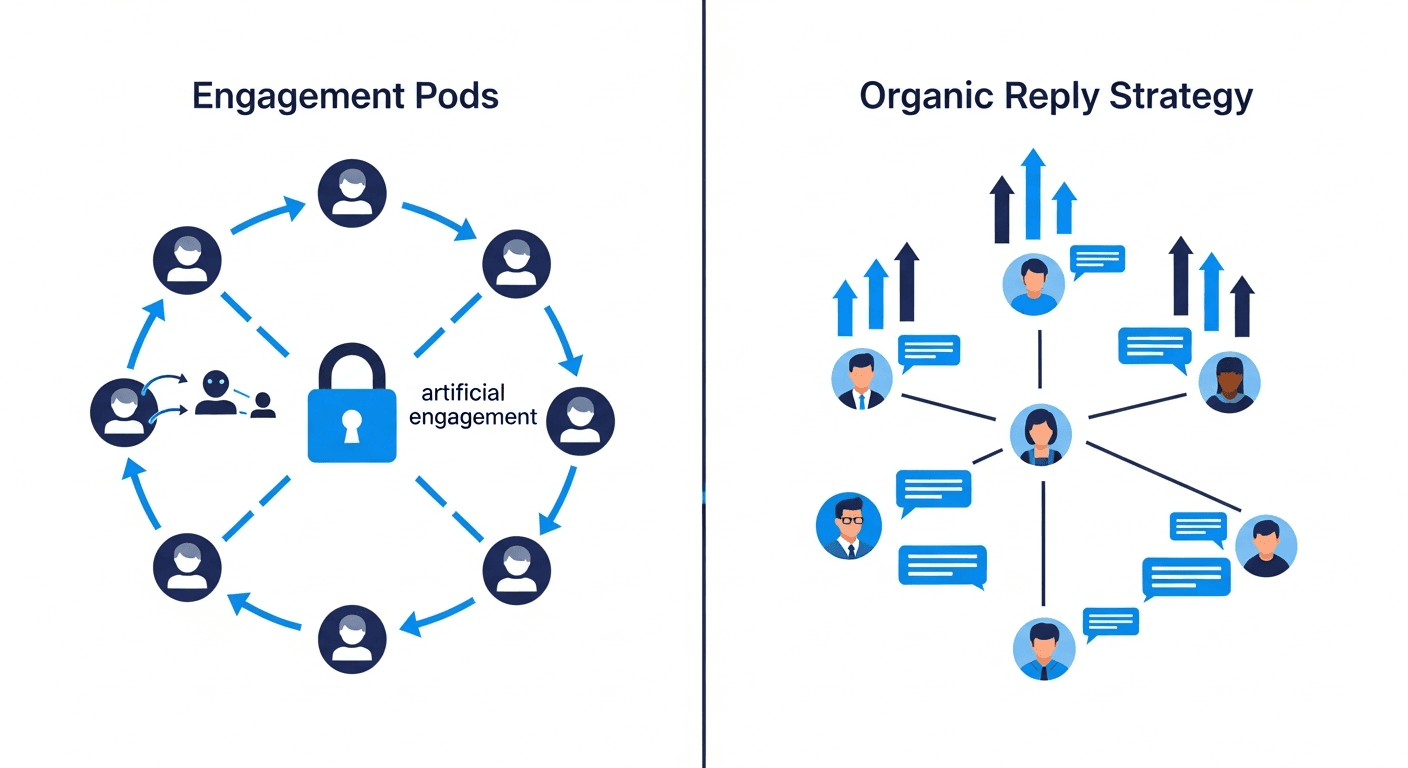
If you have been on X for more than a year, someone has probably pitched you on an engagement pod. A private group where everyone agrees to like, reply to, and retweet each other's posts on a schedule. The logic made sense: the algorithm rewards early engagement, so coordinating that engagement artificially should force posts into more feeds. In 2019, that logic was mostly correct.
In 2026, Twitter engagement pods range from useless to actively harmful. X engagement pods that use group coordination to fake early signals no longer deliver the reach they once promised. The algorithm has changed, the platform has changed, and the type of engagement that actually moves accounts forward looks nothing like what pods produce. This post covers what changed, why pods stopped working, and what the replacement strategy actually looks like for creators and founders building on X today.
This is not a "pods are evil" lecture. It is a mechanics explanation. Once you understand why pods fail now, the better approach becomes obvious.
What Twitter Engagement Pods Actually Are
An engagement pod, or X engagement pod as the platform-agnostic version is now called, is a coordinated group of accounts, usually organized in a Telegram channel, Slack group, or DM thread, where members agree to engage with each other's content shortly after posting. The typical format: someone drops a link to their new tweet, and everyone in the pod visits, likes, and replies within the first 15-30 minutes.
The theory behind this comes from how social algorithms weight early engagement. Platforms interpret a post getting lots of interaction quickly as a signal that it is good content worth amplifying. Pods attempt to fake that signal to trigger organic distribution.
There are a few variations. Some pods are reciprocal, meaning every member engages with every post. Others are tiered, where you earn engagement credits by giving them first. Some are niche-specific (SaaS founders, crypto, fitness) and some are general. In all cases, the core mechanic is the same: artificial early engagement manufactured to look organic.
At peak pod usage, roughly 2018 to 2021, this worked on Twitter, Instagram, and LinkedIn simultaneously. Marketers wrote case studies about it. Growth hackers sold pod access as a service. Then the platforms started catching on. Twitter engagement pods became the first casualty as X overhauled its ranking signals.
Why Pods Worked in 2019 But Fail in 2026
The core problem is that X's algorithm has learned to distinguish between coordinated engagement and genuine engagement. Twitter engagement pods trigger every pattern the algorithm now treats as suspicious. This is not speculation. The platform has been public about developing systems to detect inauthentic coordinated behavior, and the signals it uses go well beyond simple engagement counts.
Three specific algorithm changes killed the Twitter pod strategy as a reliable growth tactic.
First, the algorithm now weights the relationship between the person engaging and the post author. A reply from someone who has never interacted with your account before, who is in a different niche, who follows none of your followers, and who drops a generic five-word reply carries almost no signal value. Pod engagement tends to look exactly like this because pod members are often loosely related at best.
Second, X has gotten significantly better at detecting velocity patterns. Eighteen replies in twenty minutes from accounts that all engaged with each other yesterday is a detectable pattern. The platform does not necessarily ban you for it, but it suppresses the amplification that pods were designed to trigger. You get the engagement metrics without the distribution benefit.
Third, the platform shifted toward prioritizing reply quality in its content ranking. A generic reply like "great post" or "this is so true" contributes almost nothing to how a post is ranked. Substantive replies from relevant accounts in your niche still carry weight. Pod replies are structurally incapable of providing the latter at scale because the pod members are not genuine domain experts in your specific topic.
The result: Twitter engagement pods still produce vanity metrics. Your like count goes up. Your reply count goes up. Your reach does not. And once you are dependent on artificial early engagement, you become less likely to produce the kind of post that earns organic engagement, because you lose the feedback signal that tells you what actually resonates.
The X Algorithm in 2026: What It Actually Rewards
Understanding what replaced the Twitter pod strategy requires understanding what the current algorithm actually measures. If you have been Googling how to boost Twitter engagement, this is the section that matters. Based on observed patterns from accounts that have grown consistently on X through 2024 and 2025, a few signals appear to matter most.
Follower-to-engagement ratio from relevant accounts. A reply or like from someone who also follows accounts in your niche, and whose followers overlap with yours, carries more weight than the same action from an unrelated account. The algorithm is modeling whether your content is reaching its intended audience, not just whether it is getting clicks.
Sustained engagement over the first few hours, not just a spike in the first fifteen minutes. The old pod logic was about gaming the first window. The current algorithm seems to look at engagement patterns over a longer window, and a natural curve, starting slower then building, often performs better than a sharp spike followed by nothing.
Saves and bookmarks. These have become one of the highest-weight signals because they indicate intent. Someone bookmarking a post is signaling they want to return to it, which is a much stronger quality signal than a like. Pods cannot generate authentic saves because pod members have no genuine interest in the content.
Reply quality on your own posts. When you write substantive replies to comments on your posts, the algorithm treats the post as more active and surfaces it to more people. Being present in your own reply thread is one of the highest-leverage things you can do immediately after posting, and it requires no coordination with anyone.
The Strategy That Actually Replaced Pods: Being a Reply Guy
The term "reply guy" has a mildly negative connotation from the era when it described men leaving unsolicited opinions on women's posts. Reclaimed for growth purposes, it describes something completely different: an account that consistently shows up in the replies of larger accounts in a specific niche, adding genuine value.
The mechanics of why this works are the inverse of why pods fail. When you reply to a post from an account with 50,000 followers, your reply is visible to their entire audience. If your reply is substantive, smart, or funny, a percentage of their followers will click your profile. If your profile is coherent and your pinned content is strong, a percentage of those visitors will follow you. This is earned reach in a niche you actually want to be in.
The strategy has a few requirements. You need to be fast. Top replies go to accounts that show up early, which means monitoring accounts in your niche as they post. You need to add something. A reply that restates the original post, agrees generically, or adds nothing specific gets ignored. The replies that get clicks are the ones that add a data point, a counterexample, a personal experience, or a sharp observation the original poster did not make. And you need to be consistent. Showing up once gets you nothing. Showing up in the same conversations for weeks builds recognition.
This is precisely why the reply guy strategy as a growth system becomes relevant. The bottleneck is not knowing what to write. Most people in a niche have genuine opinions about the topics in that niche. The bottleneck is the time and mental load of monitoring dozens of accounts, identifying which posts are worth replying to, and generating a response that sounds like you rather than a template. That is a workflow problem, not a talent problem.
Tools that solve the workflow problem, like XreplyAI, focus on the specific friction points: surfacing posts from accounts worth engaging with, drafting reply options that match your voice and perspective, and letting you review and send quickly rather than starting from a blank text box every time.
How Voice Matching Changes the Reply Guy Equation
After abandoning Twitter engagement pods, the biggest risk with using any AI-assisted reply tool is that your replies start sounding like everyone else using the same tool. Generic, slightly too polished, clearly templated. This is worse than no reply at all because it damages your perceived authenticity, which is the entire asset the reply guy strategy is building.
The answer to this is voice matching: training the AI on your own writing rather than using a general-purpose tone. When you import your Twitter archive to build an AI voice profile, the model learns your specific patterns: the way you start sentences, the phrases you use, how formal or casual you run, your characteristic ways of disagreeing or agreeing, your sense of humor if you have one.
The practical result is that AI-drafted replies feel like you wrote them, not like they came from a content mill. Your regular followers cannot tell the difference. Accounts you are trying to get noticed by see a distinctive voice, not a polished non-entity. And because the drafts require minimal editing, you can actually maintain the consistency the strategy requires without burning several hours per week on it.
This is the specific thing that pods never offered: a way to be present and distinctive in relevant conversations at scale. Pods gave you fake numbers. The reply strategy, with voice-matched AI assistance, gives you real presence.
Building a Sustainable Engagement System Without Pods
For founders and creators who want to replace Twitter engagement pods with something that actually works in 2026, the system has three components.
First, build a target list. Identify 20-40 accounts in your niche that your ideal followers also follow. These should be accounts that post frequently, have engaged audiences, and discuss topics where you have genuine things to add. This list is your engagement feed. You are not following them to learn from them. You are following them to show up in their reply threads.
Second, set a daily reply target you can actually sustain. Five to ten substantive replies per day is enough to build meaningful presence in a niche over 60-90 days. This sounds small but it compounds. You are not trying to reply to everything. You are trying to be the person who always has something smart to say about a specific set of topics.
Third, use your own posts to continue conversations, not to start them from scratch. The best-performing organic growth strategy on X right now is writing posts that connect to conversations already happening in your niche, then being present in the replies of those posts. Think of your timeline as a way to attract people who already saw you in someone else's reply thread and wanted to hear more from you. The tweet analyzer can show you which of your posts generate this kind of follow-through engagement versus which ones get likes and nothing else.
None of this requires pods, coordinated groups, or artificial manipulation. It requires showing up with something worth saying, consistently, in the right conversations. That is what grows accounts in 2026. The tools that exist now make the consistency part dramatically easier, which is the only part that was ever actually hard.
Twitter engagement pods were once a logical response to an early-stage algorithm that could be gamed with coordinated behavior. That algorithm no longer exists. What replaced it rewards relevance, consistency, and genuine presence in specific conversations. The good news is that the strategy replacing X engagement pods, showing up as a knowledgeable voice in your niche's reply threads, is more durable, more defensible, and more likely to build an audience that actually cares about what you are building.
If the consistency requirement is the bottleneck, that is a solvable problem. XreplyAI is built specifically for founders and creators who want to run a serious engagement strategy without it consuming their day. Voice-matched replies, post scheduling across platforms, and tools for understanding what content performs, all in one place. Try it free and see whether the reply strategy works better than the pod ever did.
FAQ
- Do Twitter engagement pods still work in 2026?
- Not in any meaningful way. Pods can still inflate vanity metrics like like counts and reply counts, but X's algorithm has become effective at identifying coordinated inauthentic engagement and suppressing its distribution value. You get the numbers without the reach. Accounts relying on pods typically plateau because they lose the organic feedback signal that tells them what content actually resonates.
- Are engagement pods against Twitter's terms of service?
- Coordinated inauthentic behavior is prohibited under X's platform manipulation policies. Twitter engagement pods that use automated tools to execute engagement are clearly in violation. Manual pods, where humans choose to engage with each other, exist in a grayer area, but X has suspended accounts for coordinated artificial amplification regardless of whether automation was involved. The risk profile has increased as detection has improved.
- What is the best alternative to Twitter engagement pods for growing an account?
- The most effective replacement for Twitter engagement pods is a systematic reply strategy: identifying the 20-40 most influential accounts in your niche, showing up in their reply threads with substantive responses early after they post, and maintaining that consistency over 60-90 days. This generates real impressions from relevant audiences rather than artificial metrics from unrelated accounts. Tools like XreplyAI can help you maintain the consistency required without spending hours per day on manual work.
- How long does it take to grow on X without pods?
- The honest answer is three to six months of consistent effort before growth feels self-sustaining. The reply strategy compounds over time because recognition builds in a niche before follower counts reflect it. Accounts that stick with five to ten quality replies per day in a specific niche for 90 days consistently report meaningful follower growth in months three and four. The first two months feel slow. This is normal.
- Does the X algorithm still reward early engagement on posts?
- Early engagement still matters, but the quality and relevance of that engagement has become more important than raw speed. This is the core reason Twitter engagement pods fail even with fast execution. A few substantive replies from accounts in your niche in the first hour carries more weight than twenty generic replies from unrelated accounts. The algorithm is modeling whether your content is finding its intended audience, not just whether it is getting clicks. This is why pods fail even when they execute quickly.