Twitter Impressions vs Engagement: Which Metric Matters
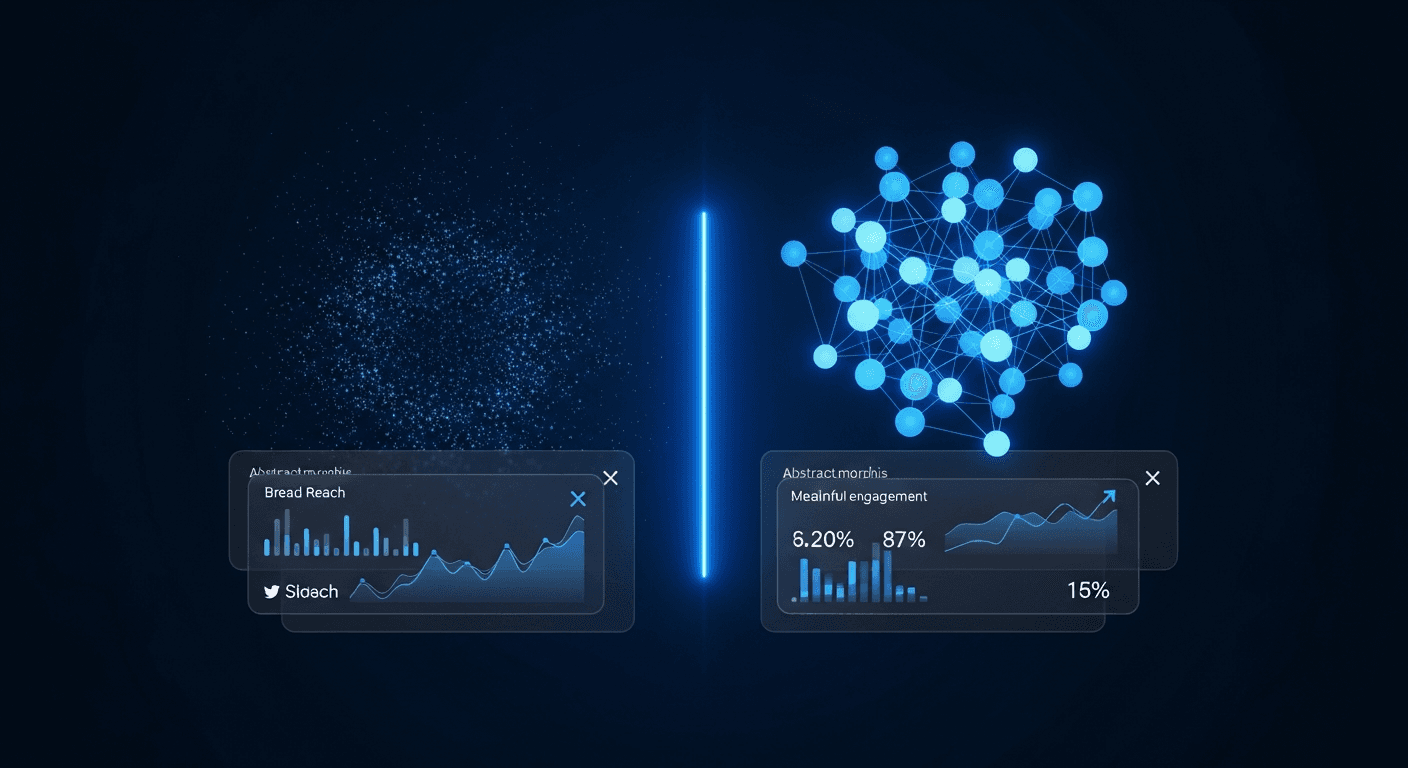
You open your X analytics dashboard and see a tweet with 40,000 impressions. Feels like a win. Then you notice another tweet with 3,000 impressions that generated 12 replies, 40 retweets, and 60 new followers. Which one actually moved the needle? That question sits at the core of the Twitter impressions vs engagement debate, and it separates creators who grow on X from those who just post into the void.
Twitter impressions vs engagement is not a trivial distinction. It determines where you spend your time, what content you double down on, and how you measure real progress. Get it wrong and you will optimize for a metric that flatters your ego while starving your account of the signals that actually drive growth.
This guide breaks down both metrics precisely: what each one measures, when each one matters, and what numbers you should target based on your follower count. By the end you will know exactly which metric to watch, which to file as context, and what to do when either one drops.
What Are Twitter Impressions?
An impression is recorded every time your tweet appears on someone's screen. This includes appearances in the home timeline, search results, profile pages, and embedded tweets on external sites. Crucially, an impression does not require the person to stop scrolling, read the tweet, or take any action. It just has to render on their screen.
X counts impressions per individual view. So if the same user scrolls past your tweet three times across three separate sessions, that counts as three impressions. This is worth understanding because impression counts can look more impressive than the underlying reach.
What impressions tell you: the algorithmic distribution of your content. A high impression count means the algorithm pushed your tweet into many timelines. A low impression count, even on content you thought was strong, often signals that the algorithm deprioritized it early, possibly because the initial engagement signals were weak in the first 15-30 minutes after posting. If impressions fall off a cliff across every post rather than one, run a shadow ban check before rewriting your content.
Understanding Twitter impressions vs engagement starts here: impressions do not tell you whether anyone cared. A tweet can rack up 100,000 impressions and generate zero replies, zero profile visits, and zero new followers. That is the trap. Treating impressions as a success metric leads creators to optimize for reach while ignoring whether the reach is converting into anything meaningful.
Impressions have a legitimate use case: brand awareness campaigns and sponsored content. If you are running paid promotions or trying to establish name recognition at scale, raw eyeballs matter. For organic growth on X, impressions are a leading indicator at best and vanity at worst.
What Is Engagement Rate on X?
Engagement rate is the percentage of people who saw your tweet and did something with it. The standard calculation: total engagements divided by total impressions, multiplied by 100. Engagements include likes, retweets, quote tweets, replies, link clicks, profile clicks, and follows generated from the tweet.
X's native analytics breaks this down further into detail expands and media views, which inflates the raw number. For a cleaner signal, most practitioners track what you might call active engagement: replies, retweets, quotes, and profile visits. These actions require intentional effort from the viewer and are much harder to accumulate passively.
In any Twitter impressions vs engagement comparison, engagement rate is the more honest metric: it normalizes for distribution. A small account with 500 followers and a 6% engagement rate is outperforming a large account with 50,000 followers and a 0.4% engagement rate on a per-viewer basis. The small account's audience is more responsive, more loyal, and more likely to amplify content organically.
The X algorithm pays close attention to early engagement signals. Tweets that generate replies and retweets within the first 30 minutes get pushed to a wider audience. This creates a compounding dynamic: high engagement rate today means more impressions tomorrow. Optimizing for engagement rate is, counterintuitively, the faster path to high impressions over time.
For more context on what is a good engagement rate on X broken down by account tier, the data shows significant variation depending on niche and follower count.
Twitter Impressions vs Engagement Rate: A Practical Comparison
Here is how the two metrics differ in practice across every dimension that matters for a creator or founder building on X.
| Factor | Impressions | Engagement Rate |
|---|---|---|
| What it measures | How many times your tweet was displayed | What percentage of viewers took action |
| Algorithm signal | Lagging indicator (result of distribution) | Leading indicator (drives future distribution) |
| Audience quality signal | None | Strong |
| Best use case | Brand awareness, paid campaigns | Organic growth, content quality testing |
| Can be gamed? | Yes, via paid promotion or viral accidents | Harder to game; requires genuine resonance |
| Predictive of follower growth? | Weakly | Strongly |
The key takeaway from the Twitter impressions vs engagement comparison: impressions tell you what happened to a tweet after distribution was decided. Engagement rate tells you whether that distribution was earned and whether it will recur. For a creator trying to build a sustainable presence, engagement rate is the metric that predicts tomorrow's numbers. Impressions just report on yesterday's.
This does not mean impressions are worthless. If you are pitching yourself for brand partnerships or sponsorships, a verified impression count is often part of a media kit. If you are testing whether a topic has broad reach potential, a spike in impressions with no engagement is still a signal, just a negative one about fit between the topic and your audience.
Engagement Rate Benchmarks by Follower Tier
What counts as a good engagement rate on X varies considerably by account size. Larger accounts consistently see lower engagement rates as a percentage because their audiences are more diffuse and include more passive followers accumulated over time.
| Follower Tier | Avg Impression Count per Tweet | Good Engagement Rate | Strong Engagement Rate |
|---|---|---|---|
| Under 1,000 | 200-800 | 3-5% | 6%+ |
| 1,000-5,000 | 500-3,000 | 2-4% | 5%+ |
| 5,000-20,000 | 2,000-15,000 | 1.5-3% | 4%+ |
| 20,000-100,000 | 10,000-60,000 | 0.8-2% | 3%+ |
| 100,000+ | 50,000+ | 0.3-1% | 2%+ |
If your engagement rate is below the average for your tier, the problem is usually one of three things: posting at the wrong time, content-audience mismatch, or low reply activity. The third factor is the most underrated. Accounts that actively reply to other people's tweets in their niche consistently outperform accounts that only publish original content. Replies put your profile in front of engaged audiences who are already in the right mindset to follow and interact.
For a deeper breakdown of benchmarks with niche-by-niche data, the engagement rate benchmarks guide covers over a dozen content categories.
When Impressions Actually Matter
There are specific contexts where prioritizing impressions over engagement rate makes sense. Knowing when to shift your focus prevents you from dismissing a useful metric entirely.
Brand awareness at early stage: if you are comparing Twitter impressions vs engagement for a brand-new account, in the first 30-60 days with under 500 followers, raw impressions matter more than they will later. You need a baseline distribution to test what content resonates. Zero impressions means zero data. Getting to 1,000+ impressions per tweet, even with modest engagement, gives you a sample size to work with.
Launching something time-sensitive: product launches, event announcements, and limited-time offers benefit from maximum reach regardless of engagement quality. In these cases you want as many eyeballs as possible in a short window. This is where using a best time to post on X tool becomes useful, stacking impression-boosting timing with content that already converts well.
Tracking algorithmic distribution changes: if your impressions drop suddenly without a corresponding drop in engagement rate, that is a signal of algorithmic change or account-level throttling, not content quality issues. Monitoring impression trends independently helps you separate signal from noise when diagnosing why growth has stalled.
Media kit and sponsorship pitches: in sponsorship conversations, Twitter impressions vs engagement are both requested, but brands often lead with impression counts as the primary currency. Engagement rate matters too, but in the sponsorship world, impressions are still the primary currency. Understanding how to report both accurately is part of monetizing an X audience.
The Highest-Leverage Way to Improve Engagement Rate
Once you have settled the Twitter impressions vs engagement question in favor of engagement rate, the obvious next question is: what actually moves it? There are three levers, ranked by impact.
First, reply strategy. Replying consistently to high-traffic tweets in your niche is the single highest-leverage activity for improving engagement rate on your own content. When you leave a sharp, specific reply on a tweet that is already getting traction, you get in front of an audience that is already engaged and topically aligned. A percentage of those people visit your profile, like what they see, and follow. Those followers are warmer than anyone you would reach from a standalone tweet, and they engage at higher rates going forward.
This is the mechanism behind what practitioners call the reply guy strategy. The label undersells it: it is not about volume of replies but about quality of placement. One reply on the right tweet at the right time can generate more profile visits than ten original tweets combined.
Second, content-audience fit. Use your tweet analyzer to identify which of your recent tweets had the highest engagement rate, not just the highest impressions. The pattern in those tweets, topic, format, length, tone, is your content-audience fit fingerprint. Double down on those patterns.
Third, posting time optimization. Even good content posted at the wrong time will underperform. The first 30 minutes of engagement signal determines how broadly X distributes a tweet. If your core audience is not online when you post, your initial signals are weak and distribution stays limited. Understanding when to post on Twitter for your specific audience is a simple fix that compounds over time.
XreplyAI is built around all three levers. It generates replies that sound like you, not a bot, so your reply activity builds genuine authority in your niche. The voice profile trained on your own tweet archive means every reply and post stays on-brand without you having to think about it.
Twitter impressions vs engagement is not a close call for most creators and founders. Impressions tell you that the algorithm delivered your content. Engagement rate tells you whether your content deserved to be delivered. Impressions are a distribution outcome. Engagement rate is the quality signal that shapes every future distribution decision the algorithm makes about your account.
Track both, but optimize for engagement rate. Build your reply presence in your niche, study which of your tweets earn the highest engagement rate (not just the most impressions), and post when your audience is actually online. Those three habits, done consistently, compound into the kind of growth that feels inevitable in hindsight. Start with a free account at XreplyAI to put your reply strategy on autopilot without sacrificing the voice that makes your content worth following.
FAQ
- What is the difference between impressions and engagement on Twitter?
- Impressions count how many times your tweet appeared on a screen, regardless of whether anyone interacted with it. Engagement measures actions taken: likes, retweets, replies, and clicks. The Twitter impressions vs engagement distinction matters because engagement rate (total engagements divided by impressions) reflects actual audience response, while impressions just count distribution volume.
- Should I focus on impressions or engagement rate for growth on X?
- For organic growth, focus on engagement rate. The X algorithm uses early engagement signals to decide how broadly to distribute your content, so a high engagement rate today directly causes higher impressions tomorrow. Impressions without engagement generate no followers, no replies, and no compounding growth.
- What is a good engagement rate on X in 2026?
- It depends on your follower count. Accounts under 1,000 followers should target 3-5% or higher. Accounts between 5,000 and 20,000 followers should aim for 1.5-3%. Accounts over 100,000 followers typically see 0.3-1% and anything above 2% is strong at that scale. Niche also matters: technical and B2B niches tend to see lower rates than entertainment or lifestyle content.
- Why do my impressions keep going up but my followers stay flat?
- This is a content-audience mismatch signal. Your tweets are being seen but not converting to follows, which usually means the content is either too broad, too generic, or not giving viewers a reason to click your profile. Try tweets that reveal a specific point of view, share a counterintuitive insight, or invite a reply. Also check whether your profile bio clearly communicates what you are about.
- Do replies count as engagement on X?
- Yes. Replies are one of the highest-value engagement signals on X because they require genuine effort from the viewer. The algorithm weights replies heavily in its distribution decisions. A tweet with 5 replies and 20 likes will often outperform a tweet with 200 likes and zero replies in terms of algorithmic reach.